In highly regulated industries such as finance, healthcare, government, and telecommunications, accountability is not optional-it’s a compliance requirement.
Organizations must be able to answer critical questions about administrative activities within their database environments:
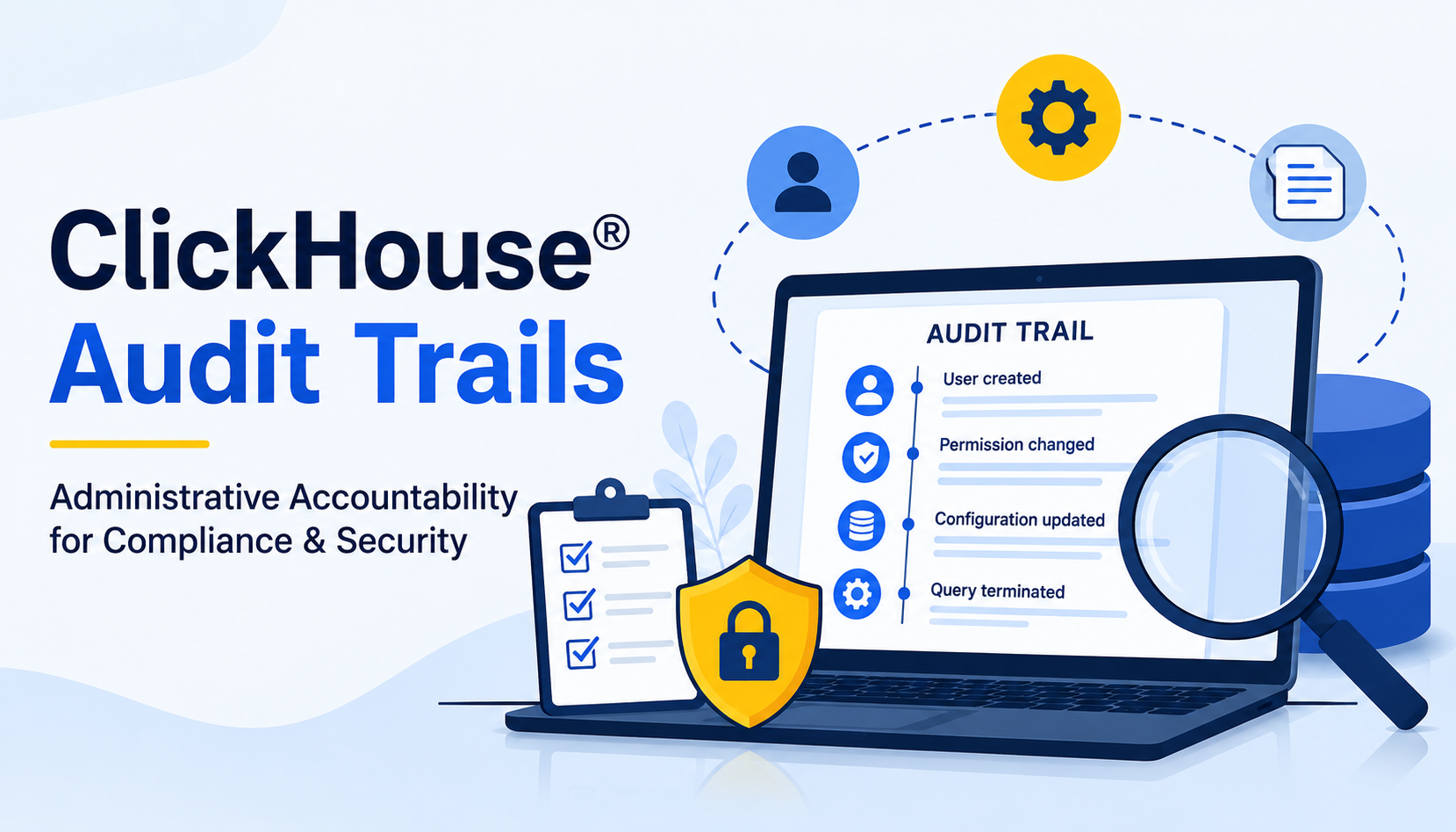
- Who created a new user account?
- Who modified access permissions?
- Who changed backup configurations?
- Who terminated a running query?
- Who altered security settings?
These questions become especially important during security investigations, compliance audits, and incident response activities.
While ClickHouse® provides powerful analytical capabilities and extensive operational logging, maintaining a complete audit trail of administrative actions can become challenging, particularly when actions are performed through third-party tools, automation platforms, or external management systems.
As organizations scale their ClickHouse® deployments, the absence of centralized administrative auditing can create operational and compliance concerns.
Why Audit Trails Matter
An audit trail is a chronological record of actions performed within a system.
For compliance teams, audit logs serve several purposes:
- Demonstrating regulatory compliance
- Tracking privileged user activity
- Supporting security investigations
- Identifying unauthorized changes
- Maintaining accountability
- Simplifying external audits
Many regulatory frameworks require organizations to maintain detailed records of administrative activities.
Examples include:
- Financial regulations
- Healthcare compliance standards
- Government security frameworks
- Enterprise governance policies
Without sufficient auditing, proving compliance becomes significantly more difficult.
The Challenge of Administrative Visibility
In a production ClickHouse® environment, multiple administrators, developers, DevOps engineers, and automation systems may interact with the platform daily.
Administrative actions can include:
User Management
Creating, modifying, or removing user accounts.
Examples:
CREATE USER analyst;DROP USER temp_user;Permission Changes
Granting or revoking privileges.
GRANT SELECT ON analytics.* TO analyst;Query Management
Stopping resource-intensive or problematic queries.
KILL QUERY WHERE query_id = 'xyz';Configuration Changes
Updating backup schedules, storage policies, cluster settings, or operational workflows.
Over time, these actions can significantly affect system behavior, security posture, and compliance status.
The challenge arises when organizations need to determine exactly who performed a particular action and when it occurred.
Compliance Teams Need Accountability
Consider a compliance audit.
An auditor may ask:
- Who created this privileged account?
- Why was this permission granted?
- Who modified the backup retention policy?
- Was the change approved?
- When was the change made?
If administrators must manually search system tables via SQL, logs, infrastructure records, automation pipelines, and third-party tools to answer these questions, the audit process becomes slow and inefficient.
Compliance teams typically expect centralized records that provide:
- User identity
- Action performed
- Timestamp
- Target object
- Source system
- Change history
Without this information, demonstrating governance becomes challenging.
Security Investigations Become More Difficult
Audit trails are equally important during security incidents.
Imagine an unexpected permission escalation occurs.
Investigators need to determine:
- Who made the change?
- When was it performed?
- Was it authorized?
- Were additional changes made?
- Which systems were affected?
Without comprehensive administrative auditing, incident response teams may spend hours reconstructing events from fragmented data sources.
This delays root cause analysis and increases operational risk.
The Operational Impact
As ClickHouse® deployments grow, so does administrative complexity.
Organizations often operate:
- Multiple clusters
- Multiple environments
- Numerous administrators
- Automated deployment pipelines
- Third-party management tools
Every additional component introduces more administrative activity that must be tracked and verified.
Without centralized visibility, maintaining accountability becomes increasingly difficult.
Regulatory Pressure Continues to Increase
Modern compliance frameworks place growing emphasis on:
- Access governance
- Privileged activity monitoring
- Change management
- Security accountability
- Audit readiness
Organizations are expected to maintain evidence that controls are functioning as intended.
The inability to quickly identify who performed an administrative action can create challenges during:
- Compliance reviews
- Internal audits
- Security assessments
- Regulatory inspections
The Real Risk
The greatest risk is not necessarily unauthorized activity.
The greater risk is being unable to prove what happened.
When audit records are incomplete or scattered across multiple systems, organizations lose visibility into administrative operations.
During audits or security investigations, uncertainty itself can become a significant operational and compliance concern.
Conclusion
ClickHouse® provides extensive operational data and monitoring capabilities, but maintaining a complete audit trail of administrative actions can become challenging in complex production environments, especially when multiple tools and automation systems are involved.
As organizations adopt ClickHouse® for increasingly business-critical workloads, accountability, governance, and compliance become just as important as performance and scalabilityThe challenge is not simply tracking database activity – it’s ensuring that every administrative action can be traced, verified, and audited when regulators, security teams, or business stakeholders need answers.