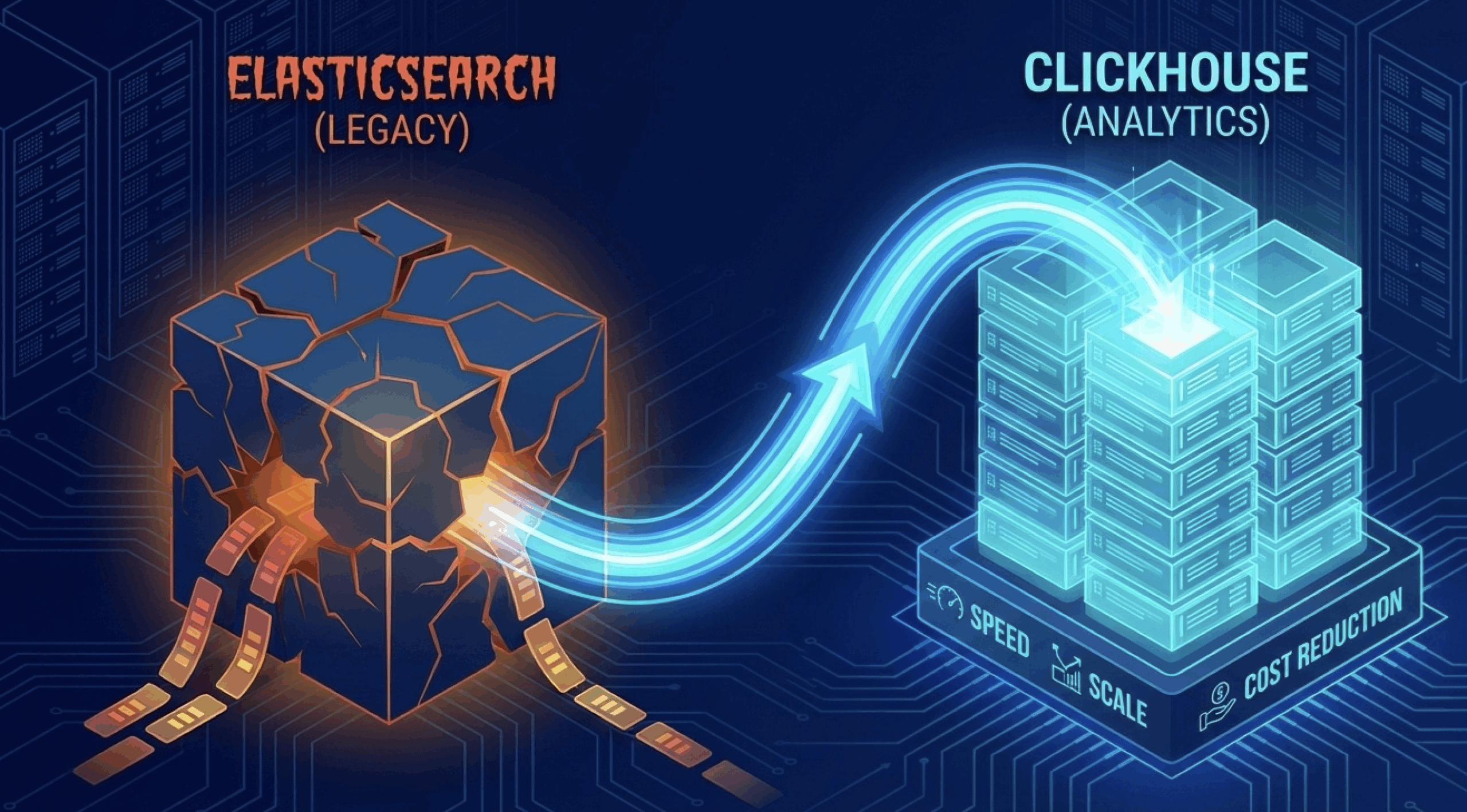
For a long time, ElasticSearch has been the default choice for log storage and analysis. It is flexible, widely adopted, and integrates well with many tools. However, as log volumes grow and retention requirements increase, many teams begin to face serious challenges with cost, performance, and operational complexity.
Because of this, more engineering teams are now evaluating ClickHouse® as an alternative to ElasticSearch specifically for log analytics. Originally built for large-scale analytical workloads, ClickHouse aligns naturally with the access patterns of logs: high-volume ingestion, time-based filtering, and aggregation-heavy queries.
This post explains why that shift is happening, when ClickHouse® makes sense as a replacement, and what trade-offs teams should understand before making the move.
Why ElasticSearch Becomes Difficult at Scale
ElasticSearch works well when log volumes are manageable. However, once ingestion grows into hundreds of gigabytes or terabytes per day, common problems start to appear.
First, memory usage becomes difficult to control. ElasticSearch is JVM-based and relies heavily on heap memory. As indices grow, garbage collection pauses and heap pressure can directly impact cluster stability.
In addition, storage costs increase quickly. Logs are highly repetitive, yet ElasticSearch does not compress them efficiently. As a result, long retention periods translate into higher disk usage and cloud bills.
Query performance can also degrade over time. Aggregations across long time ranges or high-cardinality fields often become slower and less predictable, especially under concurrent load.
Finally, operational overhead grows. Managing shards, reindexing data, tuning heap sizes, and maintaining index lifecycle policies requires constant attention. For many teams, running ElasticSearch for logs becomes a significant operational burden.
These issues are not edge cases. They are common experiences for organizations operating log-heavy systems at scale.
Why ClickHouse® Fits Log Analytics Naturally
ClickHouse® was designed from the beginning for analytical queries on large datasets. That design makes it particularly well-suited for logs.
Logs are append-only, time-series data. Most queries involve filtering by time, grouping by dimensions, and running aggregations. ClickHouse excels at these patterns.
Because ClickHouse® uses columnar storage, it reads only the columns needed for a query. This dramatically reduces disk I/O compared to document-oriented systems when running analytical workloads.
In addition, ClickHouse® applies aggressive compression. Fields such as timestamps, log levels, service names, and host identifiers compress extremely well. In real-world setups, teams often see multiple times lower storage usage compared to ElasticSearch.
Most importantly, ClickHouse® is built for fast aggregations. Counts, percentiles, group-bys, and time-bucketed analytics remain consistently fast, even across billions of log records.
Key Architectural Differences That Matter
ElasticSearch stores logs as documents inside inverted indices. This model is powerful for full-text search, but it introduces overhead when used primarily for analytics.
ClickHouse® stores logs in MergeTree tables. Data is sorted by a primary key, commonly a combination of timestamp and service identifiers, and continuously merged in the background. This results in highly optimized storage layouts for analytical access.
Scaling behavior also differs significantly. ElasticSearch relies on shards and replicas, which increases operational complexity as clusters grow. ClickHouse® scales more predictably by distributing data across nodes, without requiring shard-level tuning.
For log analytics, where queries are aggregation-heavy rather than search-heavy, ClickHouse® architecture is often a better fit.
Performance and Cost in Practice
Teams that migrate logs from ElasticSearch to ClickHouse® often observe immediate improvements.
Analytical queries that previously took seconds or minutes frequently complete in milliseconds. This is especially noticeable for dashboards and wide time-range queries.
Ingestion remains stable even at high throughput. With proper batching, ClickHouse® can ingest millions of rows per second without the indexing overhead associated with ElasticSearch.
Cost efficiency is another major advantage. Better compression and columnar storage significantly reduce disk usage. This makes longer log retention periods far more affordable.
As a result, many teams are able to reduce infrastructure costs while improving query performance at the same time.
What ClickHouse® Is Not Replacing
It is important to be clear about the boundaries.
ClickHouse® is not designed to replace ElasticSearch for advanced full-text search, relevance scoring, or fuzzy matching. If those features are central to your workload, ElasticSearch remains a strong choice.
However, for log analytics, most teams primarily filter, aggregate, and visualize data. In these scenarios, ClickHouse often provides better performance, lower cost, and simpler operations.
This is also why ClickHouse-based observability stacks, such as ClickStack, have emerged as alternatives to the traditional Elastic Stack. They reflect a broader industry shift toward analytics-first log storage.
When Replacing ElasticSearch with ClickHouse® Makes Sense
ClickHouse is a strong replacement for ElasticSearch for logs if:
- Your workload is aggregation-heavy
- Storage costs are increasing rapidly
- Query performance is inconsistent
- Long-term log retention is required
- Operational simplicity is important
If these conditions apply, ClickHouse is worth serious consideration.
Final Thoughts
ElasticSearch transformed log analytics, but it was not designed for the scale and cost constraints many teams face today. ClickHouse offers a modern alternative that aligns better with analytical log workloads.
By combining columnar storage, efficient compression, and a merge-based architecture, ClickHouse® enables faster queries, lower costs, and predictable performance.
For teams rethinking their log analytics stack, ClickHouse is no longer just an option. It is a proven and increasingly popular choice.
Looking for Expert Help with ClickHouse®?
At Quantrail Data, we help teams design, migrate, and operate ClickHouse-based log analytics platforms. From ElasticSearch migrations to performance tuning and long-term optimization, we support ClickHouse deployments at scale.
If you are evaluating ClickHouse® or planning a migration, we would be happy to help.
Contact – Quantrail Data
References
Using ClickHouse for Observability / Log Analytics
Using ClickHouse for Log Analytics
ClickStack Observability Stack
Elastic Log Monitoring & Observability Docs