Introduction
Choosing the right database is one of the most consequential architectural decisions in any modern application. If you’ve ever wondered whether to reach for ClickHouse® or PostgreSQL, you’re not alone. Both are production-grade, battle-tested databases. But they solve fundamentally different problems.
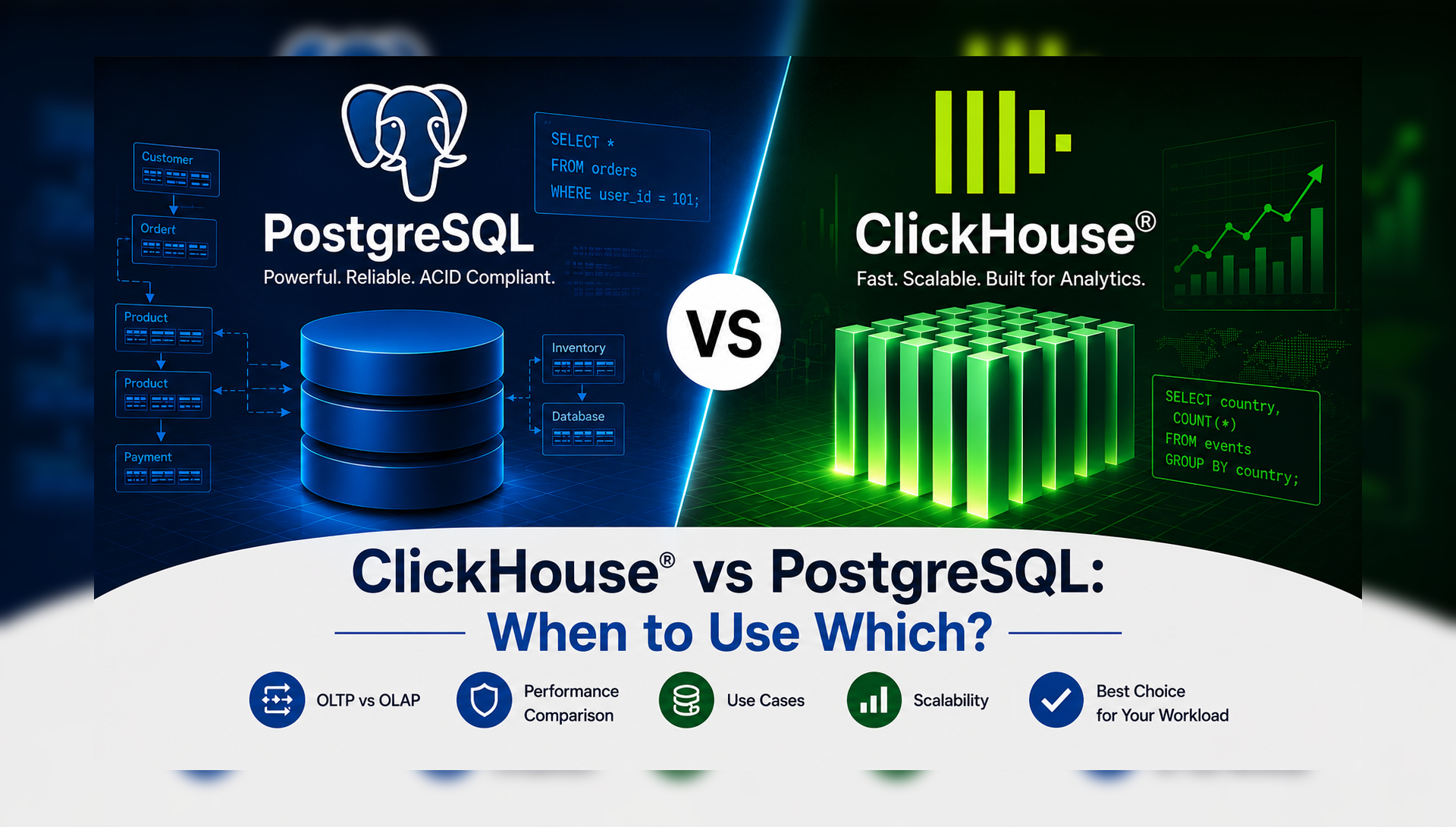
Although both are databases, they serve very different purposes:
- PostgreSQL focuses on transactional workloads (OLTP).
- ClickHouse® focuses on analytical workloads (OLAP).
This blog walks through what each database is, how their architectures differ, how they perform under different workloads, and most importantly, when to choose which.
What is PostgreSQL?
PostgreSQL is an open-source relational database designed primarily for transactional systems where data integrity, consistency, and complex relationships matter.
Commonly used for:
- Web and SaaS applications.
- Banking and financial systems.
- E-commerce platforms.
- CRM and ERP software.
Key Features:
- Full ACID compliance.
- Strong consistency and data integrity.
- Rich SQL support with complex joins.
- Row-level locking and MVCC (Multi-Version Concurrency Control).
- JSON support and a rich extension ecosystem.
PostgreSQL is the right foundation whenever your application is doing frequent INSERT, UPDATE, and DELETE operations and correctness is non-negotiable.
What is ClickHouse®?
ClickHouse® is a high-performance columnar database built for analytical processing at scale. It was optimized for massive data ingestion, Fast aggregation, Real-time analytics and Time-series analysis.
Commonly used for:
- Real-time analytics and BI dashboards.
- Log and event processing.
- Observability and monitoring platforms.
- Time-series analytics.
- Ad-tech and clickstream analysis.
Key Features:
- Column-oriented storage.
- Vectorized query execution.
- Extremely high compression ratios.
- Distributed architecture built for horizontal scaling.
- Sub-second aggregations over billions of rows.
The Core Difference: PostgreSQL vs ClickHouse®
| Features | PostgreSQL | ClickHouse® |
|---|---|---|
| Database Type | OLTP – Transactional workloads | OLAP – Analytics & Reporting |
| Storage Model | Row-based | Column-based |
| Optimized For | Transactions | Analytics |
| Read performance | Fast for point lookups | Extremely fast on large scans |
| Write Performance | Individual row inserts/updates | High-throughput bulk inserts |
| Update Frequency | Frequent updates | Mostly append-only |
| Transaction (ACID) | First-class support | Limited transactional support |
| Joins | Excellent | Limited / expensive |
| Aggregation Speed | Moderate | Extremely fast |
| Compression | Moderate | Exceptional (columnar compression) |
| Real-Time Dashboards | Limited at scale | Excellent |
| Ecosystem maturity | Decades-old, vast ecosystem | Growing fast |
ClickHouse® -> Columnar, append-heavy, built for analytical queries over billions of rows.

PostgreSQL -> Row-oriented, ACID-compliant, built for transactional workloads with complex relationships.
The distinction comes down to one question: Are you reading a few rows with many columns, or scanning millions of rows to compute aggregates?
PostgreSQL excels at the former. ClickHouse® was designed for the latter.
How They Store Data
This is where the architectures diverge most fundamentally, and understanding it makes everything else click.
PostgreSQL – Row Oriented Storage
PostgreSQL stores data row by row. When you insert a user record, all columns (ID, Name, Age) – sit together on disk:
[1, John, 25]
[2, Alice, 30]
This is great for reading or updating a single user’s profile, but slow when you only need to aggregate one column across millions of rows.
ClickHouse® – Column Oriented Storage
ClickHouse® stores data column by column:
ID:   [1, 2]
Name: [John, Alice]
Age:  [25, 30]
To compute the average age of users, it reads only the Age column, skipping everything else entirely, this is why ClickHouse® can run aggregations 10–100x faster than row-based systems on large datasets.
Storage Efficiency
Storage requirements become important as data volumes grow.
-
PostgreSQL is optimized for transactional workloads and provides efficient storage for operational data.
-
ClickHouse® benefits from columnar storage and typically achieves much higher compression ratios, making it a strong choice for storing large volumes of logs, metrics, events, and analytical data.
Typical compression ratios:
| Database | Compression |
|---|---|
| PostgreSQL | 2x–5x |
| ClickHouse® | 5x–20x+ |
Actual compression ratios vary depending on data characteristics, schema design, and compression settings.
If storage cost and long-term data retention are major concerns, ClickHouse® often has an advantage.
Architecture Comparison
PostgreSQL Architecture
PostgreSQL is single-node by default. It relies on B-tree indexes and MVCC (Multi-Version Concurrency Control) for reliable concurrent access.
Scaling is primarily vertical, adding more CPU and RAM to a single machine, though read replicas can help distribute read workloads. This approach works well for most transactional applications but becomes increasingly complex at very large scale.
Strengths:
- Reliable, mature transaction handling.
- Excellent data integrity.
- Rich ecosystem of tools and extensions.
ClickHouse® Architecture
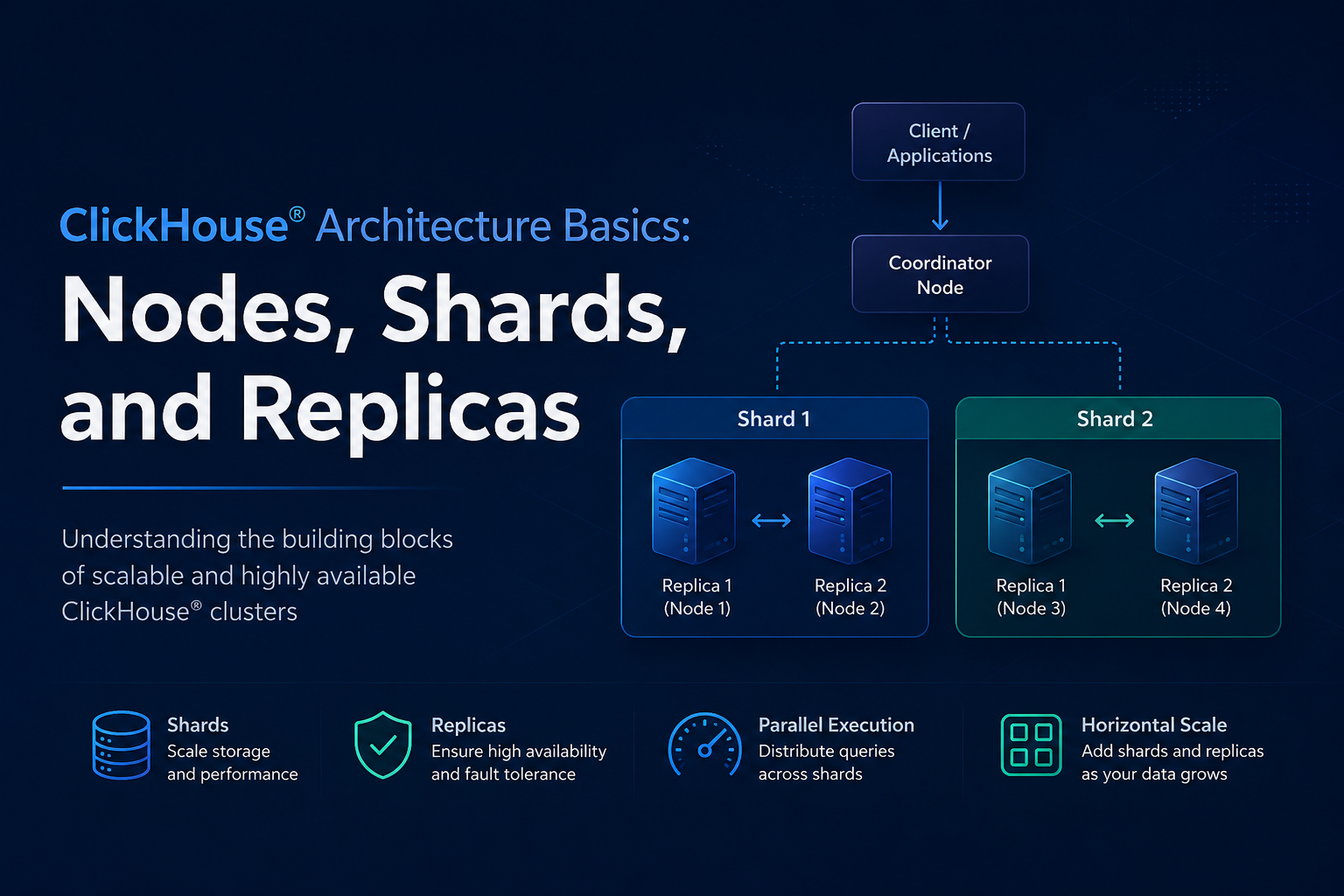
ClickHouse® is distributed-first. It uses parallel query execution and vectorized processing, making it well-suited for horizontal scaling across clusters. Data can be distributed across multiple nodes, allowing ClickHouse® to efficiently process analytical workloads involving billions of rows and petabytes of data.
Strengths:
- Handles billions of rows efficiently.
- High-speed analytical queries.
- Excellent horizontal scalability.
- Built-in replication and sharding support.
| Dimensions | PostgreSQL | ClickHouse® |
|---|---|---|
| Default Design | Single Node | Distributed |
| Storage Layout | Row-Oriented | Column-Oriented |
| Scaling Approach | Vertical Scaling | Horizontal Scaling |
| Query Execution | Process-Based Execution | Parallel Processing |
| Indexing Strategy | Traditional Database Indexes | Sparse & Data-Skipping Indexes |
| Data Distribution | External Sharding Solutions | Built-in Sharding Support |
Performance Comparison
Consider a scenario with 2 billion event records and a need for hourly analytics dashboards. PostgreSQL will slow down significantly as data grows, query times stretch from seconds to minutes at this scale. ClickHouse® can aggregate those same billions of rows within seconds, consistently.
INSERT and UPDATE Performance
| Operations | PostgreSQL | ClickHouse® |
|---|---|---|
| INSERT | Excellent | Excellent (batch inserts preferred) |
| UPDATE | Excellent | Limited |
| DELETE | Excellent | Costly |
| UPSERT | Strong support | Limited |
An important caveat: ClickHouse® is optimized for append-only, immutable data. It is not designed for systems that frequently update or delete rows that's PostgreSQL's domain.

Scanning hundreds of millions of rows and returning aggregated results in milliseconds. This is exactly what ClickHouse® was built for.
When to Use ClickHouse®
ClickHouse® shines when you’re dealing with high-volume, read-heavy workloads where query latency matters at scale.
- Business intelligence dashboards over billions of events
- Real-time analytics pipelines - > clickstream, logs, metrics
- Time-series data at massive scale
- Ad-tech, telemetry, and observability platforms
- Aggregation queries across hundreds of millions of rows
- Self-hosted data warehousing without per-query cloud costs
When to Use PostgreSQL
PostgreSQL is the go-to for application backends where data integrity, relationships, and real-time mutation matter.
- User accounts, authentication, and profile management
- E-commerce –> orders, inventory, and payments
- Booking systems, scheduling, transactional workflows
- Complex relational data with joins and foreign keys
- Applications requiring full ACID guarantees
- Frequent row-level updates and deletes
Can We Use Both?
Yes and many production systems do exactly this. The most common pattern:
- PostgreSQL stores transactional data – users, orders, payments, application state.
- An event pipeline (Kafka or direct insert) streams logs and metrics into ClickHouse®.
- Application logic reads and writes to PostgreSQL; dashboards and analytics query ClickHouse®.
Application → PostgreSQL (operational data) + Event Pipeline → ClickHouse® (analytics)This OLTP + OLAP hybrid architecture avoids forcing either database to do a job it wasn’t designed for, and is standard practice at companies like Cloudflare and various fintech platforms operating at scale.
Quick Decision Guide
| If You Need… | Choose |
|---|---|
| Banking or payment system | PostgreSQL |
| Real-time analytics | ClickHouse® |
| E-commerce backend | PostgreSQL |
| Log and event analytics | ClickHouse® |
| BI dashboards at scale | ClickHouse® |
| CRUD application | PostgreSQL |
| Massive aggregations | ClickHouse® |
| Transactional integrity | PostgreSQL |
The Verdict
Neither database is universally better. ClickHouse® doesn’t try to replace PostgreSQL, and PostgreSQL can’t match ClickHouse® at analytical scale.
PostgreSQL and ClickHouse® are not competitors, they are complements. PostgreSQL owns the transactional layer; ClickHouse® owns the analytical layer.
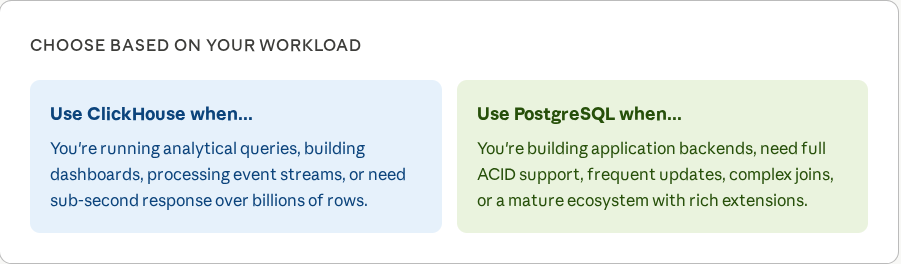
In many modern architectures, using both together provides the best of both worlds.
The question is always: what does your workload actually look like? Get that answer right, and both databases will perform beautifully. The best database isn’t the fastest one. It’s the one optimized for your workload.
The key is understanding your workload: OLTP → PostgreSQL. OLAP → ClickHouse®. Exploring ClickHouse® for Your Analytics?
At Quantrail Data, we help teams run ClickHouse® reliably for real-time analytics – from Kubernetes deployments and migrations to performance tuning in production.
We see these challenges firsthand while supporting demanding analytics workloads. In one recent engagement, a customer achieved near bare-metal performance with ClickHouse® in production – a story we’ve shared here:
Success Story: Quantrail Bare-Metal ClickHouse® Deployment
If you’re evaluating ClickHouse® or trying to get more out of an existing setup, we’re happy to share practical lessons from real-world deployments.
Contact
Quantrail Data