Modern applications generate enormous amounts of data every second. User interactions, application logs, financial transactions, IoT devices, and analytics events continuously produce information that organizations need to store and analyze. While traditional databases excel at processing individual transactions, they often struggle when asked to analyze billions of records in real time.
This is where ClickHouse® comes in.
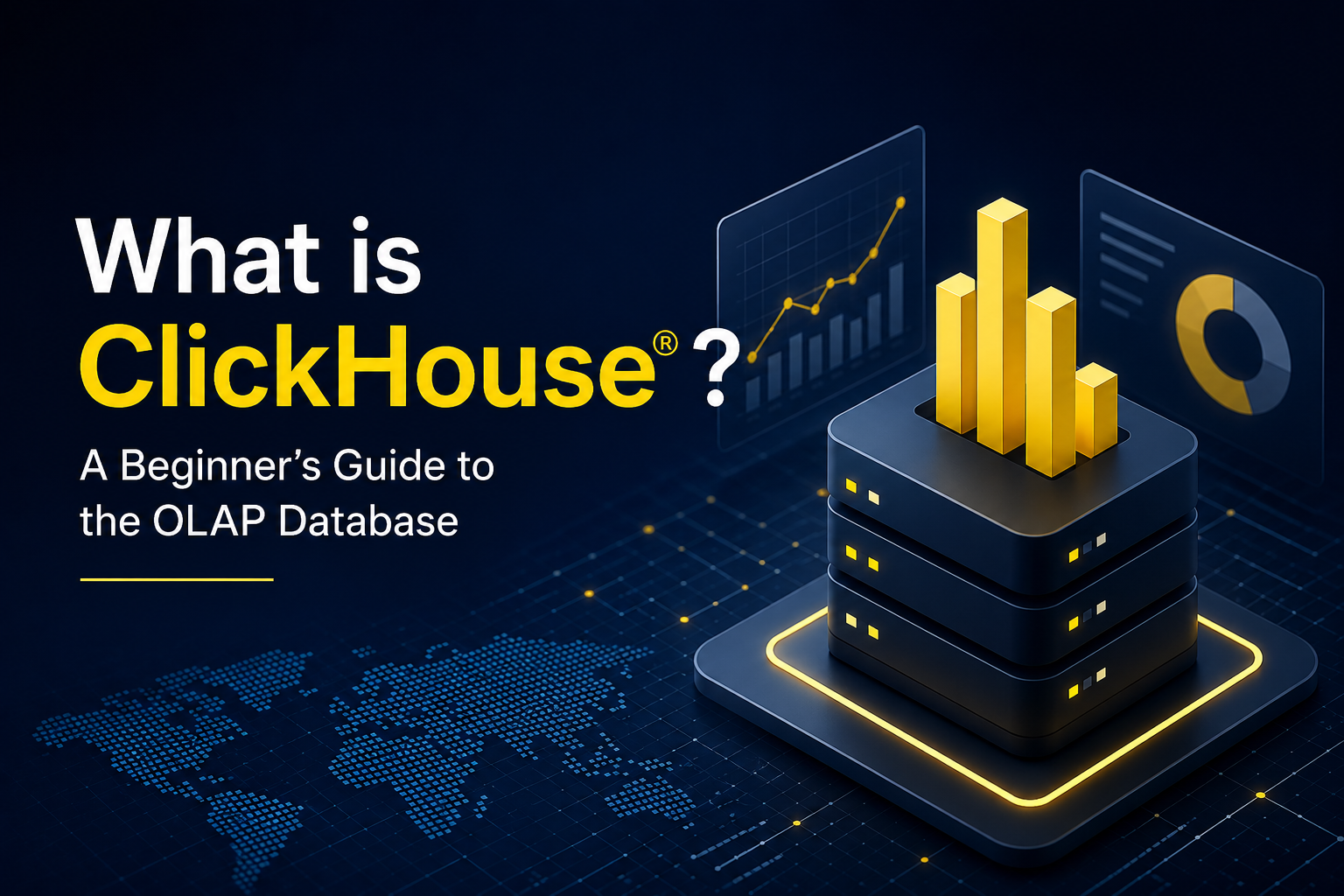
ClickHouse® is a high-performance, open-source database management system designed specifically for Online Analytical Processing (OLAP). It enables organizations to run complex analytical queries on massive datasets with exceptional speed, often returning results in milliseconds even when working with billions of rows.
In this guide, we will explore what ClickHouse® is, how it works, why it is different from traditional databases, and where it fits in modern data architectures.
Understanding OLAP Databases
Before discussing ClickHouse®, it is important to understand the concept of OLAP.
OLAP stands for Online Analytical Processing, a category of database systems optimized for analytical workloads. These workloads typically involve:
- Aggregating large amounts of data
- Running complex queries
- Generating reports and dashboards
- Performing business intelligence (BI) analysis
- Exploring historical trends and patterns
For example, an e-commerce company might ask questions such as:
- What were the total sales by region over the last year?
- Which products generated the highest revenue last month?
- How many active users visited the platform each day?
These queries require scanning and analyzing large portions of a dataset rather than updating individual records.
In contrast, Online Transaction Processing (OLTP) databases focus on handling frequent inserts, updates, and deletes, such as processing orders or managing user accounts.
What is ClickHouse®?
ClickHouse® is an open-source column-oriented database management system built for fast analytical queries on large datasets.
It was originally developed by Yandex, one of the largest technology companies in Russia, to power web analytics workloads. Later, it was released as an open-source project and has since gained widespread adoption across industries.
Unlike traditional row-based databases, ClickHouse® stores data by columns. This architectural choice allows it to process analytical queries much more efficiently.
Key characteristics of ClickHouse® include:
- Columnar storage architecture
- High-performance analytical query execution
- Horizontal scalability
- Real-time data ingestion
- Data compression capabilities
- SQL support
- Open-source ecosystem
Today, organizations use ClickHouse® for observability platforms, business intelligence systems, product analytics, financial analytics, cybersecurity monitoring, and many other data-intensive applications.
Why Was ClickHouse® Created?
As data volumes increased, traditional databases began facing challenges when handling analytical workloads.
Consider a table containing billions of website events:
| Event Time | User ID | Country | Device | Revenue |
|---|---|---|---|---|
| 2025-08-01 09:15:23 | 1001 | United States | Mobile | 49.99 |
| 2025-08-01 09:17:45 | 1002 | India | Desktop | 19.99 |
| 2025-08-01 09:20:11 | 1003 | Germany | Tablet | 79.99 |
| … | … | … | … | … |
Suppose a query only needs the Country and Revenue columns to calculate revenue by country.
In a row-based database, the entire row is typically read even if most columns are unnecessary.
In ClickHouse®, only the required columns are read from storage.
This significantly reduces:
- Disk I/O
- Memory usage
- Query execution time
As a result, analytical queries become dramatically faster.
Column-Oriented Storage Explained
The core innovation behind ClickHouse® is its columnar storage model.
Row-Oriented Storage
Traditional databases store data like this:
Row 1: A, B, C, D
Row 2: A, B, C, D
Row 3: A, B, C, D
Data for each record is stored together.
This approach is excellent for transactional operations because entire records can be retrieved quickly.
Column-Oriented Storage
ClickHouse® stores data like this:
Column A: A, A, A
Column B: B, B, B
Column C: C, C, C
Column D: D, D, D
Each column is stored separately.
When a query requires only two columns, ClickHouse® reads only those columns instead of scanning the entire dataset.
Benefits include:
- Faster analytical queries
- Better compression ratios
- Reduced storage requirements
- Lower memory consumption
These advantages make ClickHouse® particularly effective for data warehousing and analytics.
Key Features of ClickHouse®
1. Exceptional Query Performance
ClickHouse® is known for its ability to process billions of rows in seconds or even milliseconds.
Its performance comes from several optimizations:
- Vectorized query execution
- Columnar storage
- Efficient compression
- Parallel processing
- Query optimization techniques
This makes it suitable for interactive dashboards and real-time analytics.
2. Real-Time Analytics
Traditional data warehouses often require batch processing before data becomes available for analysis.
ClickHouse® supports high-speed ingestion while maintaining analytical performance.
Organizations can:
- Stream events continuously
- Analyze data immediately after ingestion
- Build near real-time dashboards
This capability is particularly valuable for monitoring and observability use cases.
3. High Compression Efficiency
Because similar values are stored together within columns, ClickHouse® achieves impressive compression ratios.
Benefits include:
- Reduced storage costs
- Faster disk reads
- Improved cache efficiency
In many workloads, datasets can be compressed several times smaller than their original size.
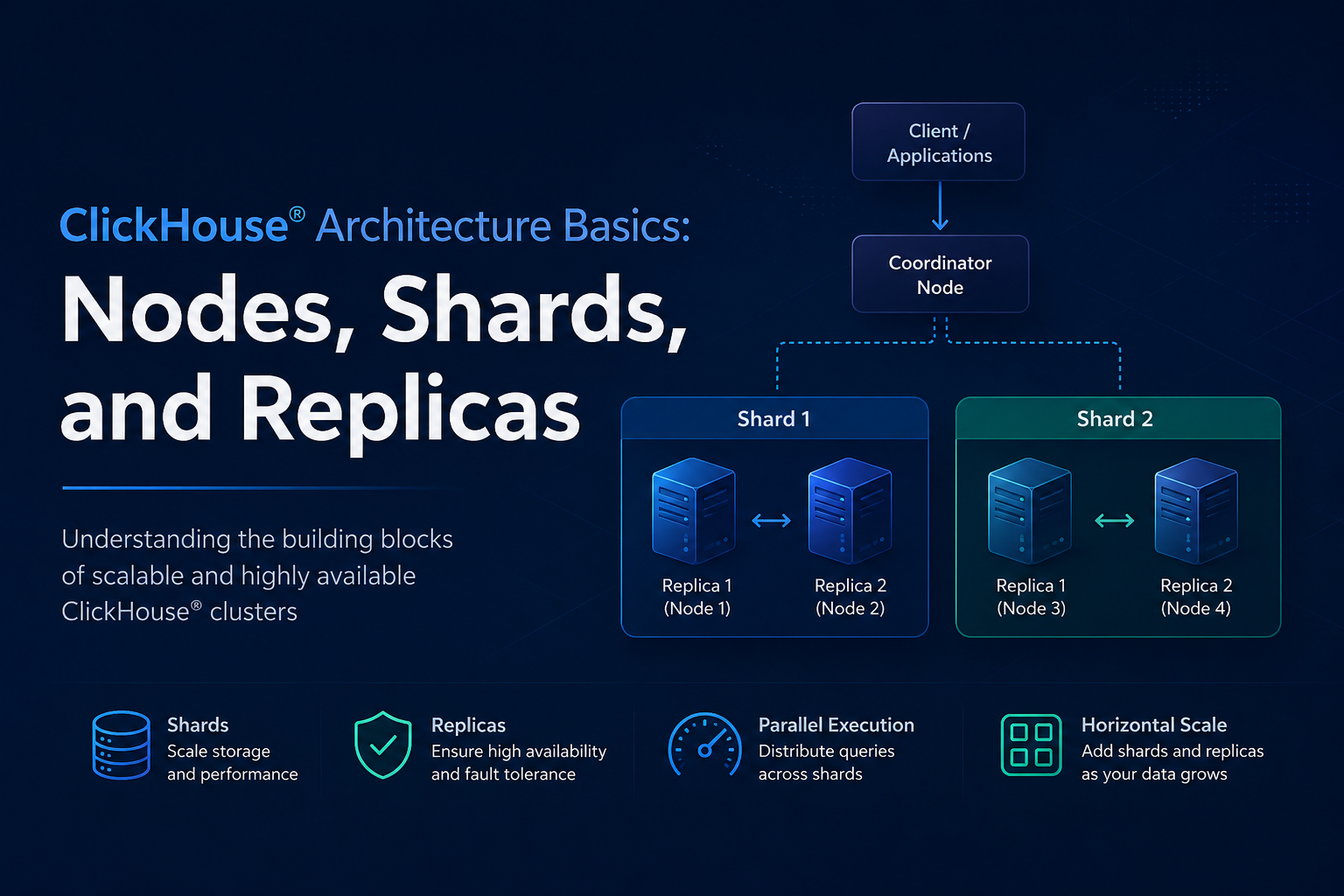
4. Horizontal Scalability
As data grows, ClickHouse® can scale across multiple servers.
Features include:
- Distributed tables
- Replication
- Sharding
- Fault tolerance
This allows organizations to manage petabytes of data without relying on a single machine.
5. SQL Support
ClickHouse® supports a SQL-based query language, making it approachable for analysts, engineers, and data teams.
Example query:
SELECT
    country,
    SUM(revenue) AS total_revenue
FROM sales
GROUP BY country
ORDER BY total_revenue DESC;
Users familiar with SQL can become productive quickly.
ClickHouse® Architecture Overview
At a high level, ClickHouse® consists of several important components.
Storage Layer
Responsible for:
- Storing columnar data
- Compressing data
- Managing partitions
- Organizing data efficiently
Query Processing Layer
Handles:
- SQL parsing
- Query optimization
- Parallel execution
- Aggregation operations
Distributed Layer
Enables:
- Cluster communication
- Data sharding
- Replication
- Distributed query execution
Together, these components allow ClickHouse® to maintain high performance even as datasets grow.
Common Use Cases for ClickHouse®
Product Analytics
Companies track:
- User behavior
- Clickstream events
- Feature adoption
- Conversion funnels
ClickHouse® enables rapid analysis of billions of user events.
Observability and Monitoring
Engineering teams use ClickHouse® for:
- Log analytics
- Metrics storage
- Application monitoring
- Infrastructure observability
Many modern observability platforms rely on ClickHouse® as their backend database.
Business Intelligence
Organizations generate reports involving:
- Revenue analysis
- Customer behavior
- Sales performance
- Operational metrics
ClickHouse® can power dashboards with low-latency query performance.
Financial Analytics
Financial institutions often need:
- Market analysis
- Risk calculations
- Trading insights
- Historical reporting
The speed of ClickHouse® makes it suitable for these demanding analytical workloads.
Cybersecurity Analytics
Security teams analyze:
- Network events
- Threat indicators
- Authentication logs
- Security incidents
Fast query performance helps accelerate investigations and threat detection.
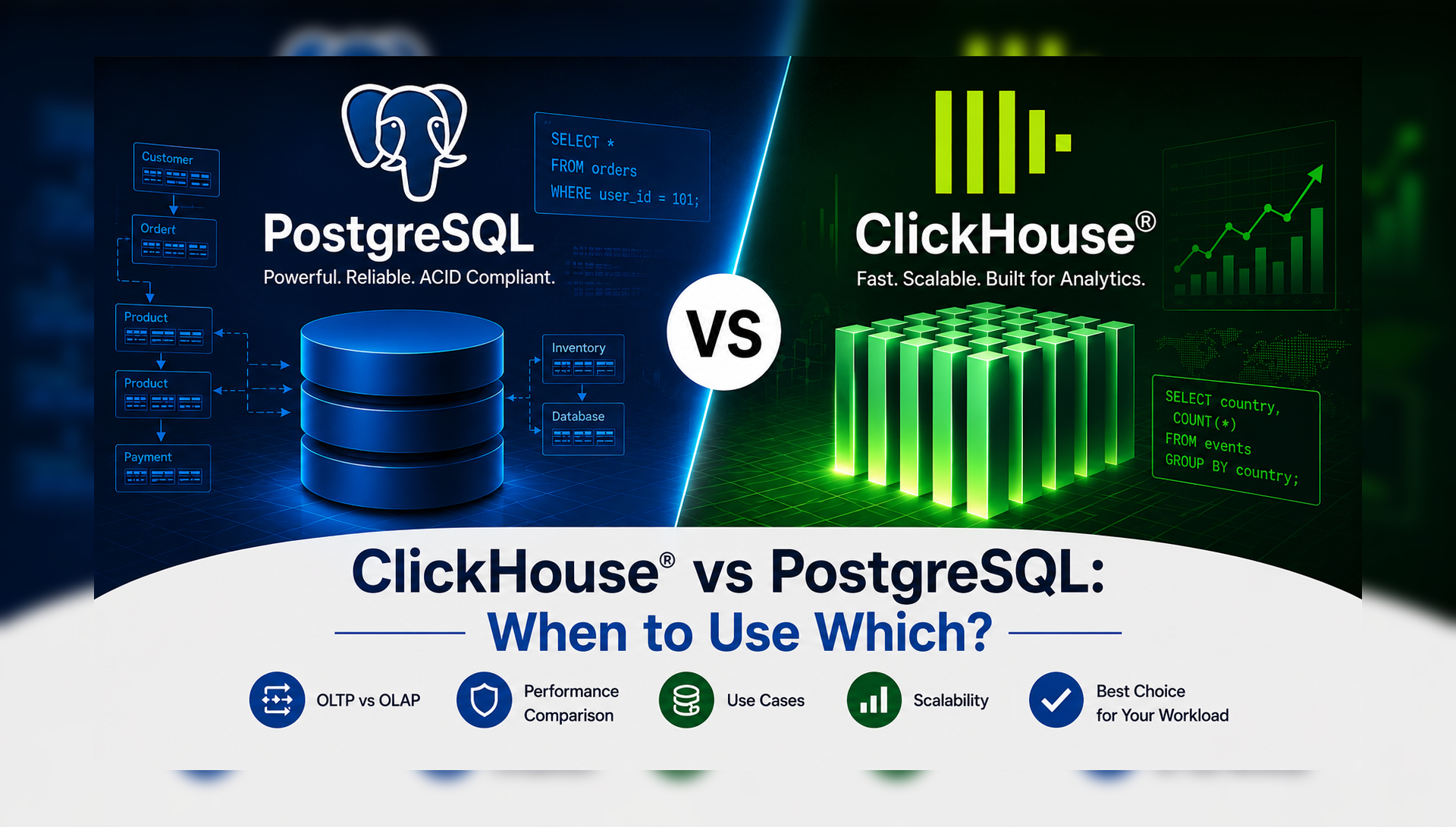
ClickHouse® vs Traditional Relational Databases
| Feature | ClickHouse® | Traditional OLTP Databases |
|---|---|---|
| Primary Purpose | Analytics | Transactions |
| Storage Model | Column-oriented | Row-oriented |
| Query Type | Aggregations and reporting | Record-level operations |
| Performance on Large Scans | Excellent | Often limited |
| Compression | High | Moderate |
| Real-Time Analytics | Strong | Limited |
| Billions of Rows | Designed for it | Often challenging |
This does not mean ClickHouse® replaces traditional databases.
Instead, many organizations use both:
- OLTP databases for operational transactions
- ClickHouse® for analytical processing
When Should You Use ClickHouse®?
ClickHouse® is a strong choice when:
- Data volumes are extremely large
- Fast analytical queries are required
- Real-time dashboards are important
- Event-based data is continuously generated
- Cost-efficient storage is needed
Typical scenarios include:
- Analytics platforms
- Monitoring systems
- Data warehouses
- Log management platforms
- Business intelligence applications
When ClickHouse® May Not Be the Right Choice
ClickHouse® is optimized for analytics, not transactional processing.
It may not be the best option for:
- Banking transaction systems
- Inventory management systems
- User account management
- Applications requiring frequent row-level updates
For these workloads, traditional OLTP databases such as PostgreSQL or MySQL are often more appropriate.
Choosing the right database depends on the nature of the workload rather than selecting a single database for every use case.
The Growing Ecosystem Around ClickHouse®
The adoption of ClickHouse® has expanded significantly in recent years.
The ecosystem now includes:
- Managed cloud offerings
- Business intelligence integrations
- Observability platforms
- Data ingestion tools
- Open-source connectors
Its combination of performance, scalability, and operational simplicity has made it a popular choice for organizations building modern analytics platforms.
As data volumes continue to increase, technologies like ClickHouse® are becoming increasingly important in helping organizations extract insights from their information efficiently.
Exploring ClickHouse® for Your Analytics?
At Quantrail Data, we help teams run ClickHouse® reliably for real-time analytics – from Kubernetes deployments and migrations to performance tuning in production.
We see these challenges firsthand while supporting demanding analytics workloads. In one recent engagement, a customer achieved near bare-metal performance with ClickHouse® in production – a story we’ve shared here:
Success Story: Quantrail Bare-Metal ClickHouse® Deployment
If you’re evaluating ClickHouse® or trying to get more out of an existing setup, we’re happy to share practical lessons from real-world deployments.
Contact
Quantrail Data
Conclusion
ClickHouse® is a high-performance, open-source OLAP database designed to analyze large-scale datasets with exceptional speed. Its column-oriented architecture, efficient compression, distributed capabilities, and real-time analytical performance make it a compelling solution for modern data-intensive workloads.
Unlike traditional transactional databases, ClickHouse® focuses on analytical processing, enabling organizations to query billions of rows, power real-time dashboards, and gain insights from massive datasets without sacrificing performance.
For engineers, analysts, and data teams looking to build scalable analytics platforms, understanding ClickHouse® is becoming an increasingly valuable skill. As the demand for fast, data-driven decision-making continues to grow, ClickHouse® has established itself as one of the leading technologies in the analytical database landscape.
References
Official ClickHouse® Documentation – https://clickhouse.com/docs